The Carbon Myth That Just Died: Fossil Leaves Show CO₂ Kills Forests, Not Greens Them
For years, a comforting myth has floated through boardrooms and fund prospectuses: that more carbon dioxide in the air is basically free fertilizer. That emissions will 'green the planet.' That trees will thrive as we pump out record levels of CO₂. A new study just torched that narrative with 56-million-year-old leaf cells — and the implications for your portfolio are anything but academic.
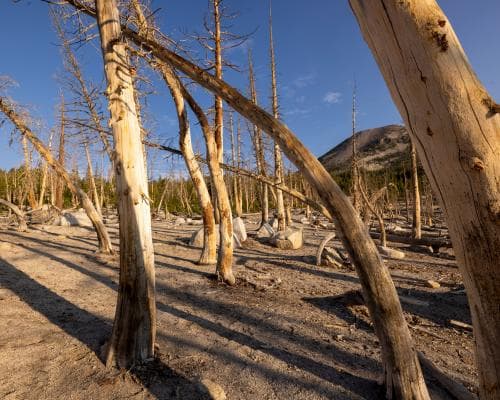
Scientists led by Regan Dunn at La Brea Tar Pits and the Natural History Museum of Los Angeles County reconstructed what happened to Earth's forests during the Paleocene-Eocene Thermal Maximum (PETM), a period about 56 million years ago when massive amounts of carbon were released into the atmosphere over roughly 130,000 years. That's the closest natural analog we have to today's fossil-fuel binge — and the results are chilling. The forests didn't get lusher. They got denser, then they collapsed. Around 60% of the standing vegetation's biomass vanished. The Earth didn't green; it browned.
Let's put that in capital terms. Sixty percent of standing biomass is not a marginal dip. It's a systemic drawdown. The study found that as CO₂ ramped up, forests initially thickened — a brief, deceptive boom — then died back dramatically, opening up landscapes and leaving them barren. Dunn describes it as a 'huge loss,' and she's right. For anyone managing money tied to land, timber, agriculture, or carbon offsets, this is a red flag planted squarely in the data.
Here's the kicker for markets: the current rate of carbon release is faster than anything in the prehistoric record, including the PETM. That means we're not just replaying an ancient script — we're accelerating it. The study's authors explicitly warn of 'chilling implications' for today's world. If forests collapse under rapid carbon loading, every asset class that depends on stable ecosystems — from farmland to insurance portfolios to the $2 billion global carbon-offset market — faces a repricing event that most models still don't capture.
Investors have long been told that CO₂ is plant food, and there's a sliver of truth: plants do need carbon. But the new research shows that the dose is the poison. When carbon hits the atmosphere too fast, forests can't adapt. They become dense, stressed, and then they die — often by fire, drought, or pest outbreaks, all of which we're already seeing in California, the Amazon, and Australia. The 'greening' narrative is not just wrong; it's dangerous because it lulls capital into complacency.
What does this mean for the wealthy? It means that 'natural capital' is not a passive, safe haven. Timberland REITs, agricultural land, and even luxury coastal properties are all underpinned by ecological stability that is now demonstrably fragile. It also means that companies touting 'nature-based solutions' for carbon offsets need far more scrutiny — if forests are dying back, those offsets are worth less than the paper they're printed on. The smart money is already shifting toward adaptation plays: water infrastructure, resilient agriculture, and climate-resilient real estate.
The takeaway is stark: the fossil record is not a dusty museum exhibit. It's a forward-looking risk model. And it's telling us that the 'green planet' fantasy is a mirage. The forests that underpin our economy are not going to save us — they're going to need saving. For investors, the question is no longer whether climate change will hit your portfolio. It's whether you're positioned for the browning, not the greening.