The 87-Game Streak That Just Broke: What Michael Adams' First British Chess Championship Loss Since 1988 Really Signals
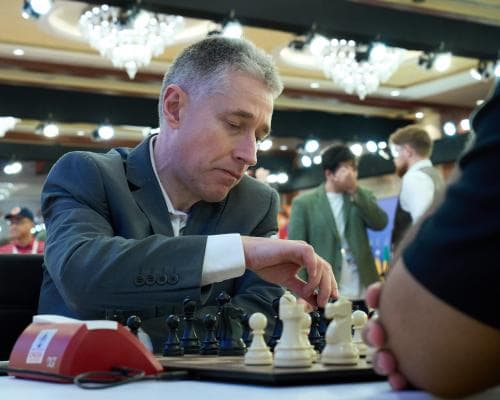
For 36 years, Michael Adams was the immovable object of British chess. A grandmaster who had not lost a single classical game in the British Championship since 1988—a streak spanning 87 games, seven titles, and a world-title campaign—finally blinked. In round four of the 2026 British Championship at the University of Warwick, the 54-year-old Taunton native resigned a lost rook endgame after 60 moves to Svyatoslav Bazakutsa, an 18-year-old Ukrainian prodigy now based in Liverpool. The streak is gone. And with it, a quiet era of dominance that wealth managers and collectors alike should read as a signal: the old guard's moat is eroding, and the new generation is not just knocking—it's breaking through.
Adams' record was not just a curiosity; it was a financial and cultural asset. Nine British titles, one shy of Jonathan Penrose's record, built over decades when Adams skipped many domestic events to chase the world crown. His 1989 victory at 17 made him the youngest British champion ever—a record that still stands. But the 2026 championship, with a modest £34,000 prize fund across 108 players, is now a stage for a youthquake. Five of the top eight after round five were under-21; four were under-18. The prize money is tiny compared to the $2 million-plus purses of elite invitationals, but the talent on display is drawing serious attention from sponsors, streaming platforms, and even hedge-fund-backed chess clubs that see the game as a data-rich, low-capital sport with explosive growth potential.
The mechanics of Adams' defeat are telling. It wasn't a blunder or a tactical oversight—it was a slow, grinding rook endgame where Bazakutsa, ranked far lower, simply out-maneuvered a veteran who has seen every position twice. Adams resigned after 60 moves, a quiet admission that the younger player's precision was unyielding. This is the kind of loss that wealth builders understand: not a crash, but a steady erosion of edge. In markets, we call it mean reversion. In chess, it's the inevitable passing of the torch. Bazakutsa, who moved to Liverpool to pursue chess, represents a new wave of migrants and young players who are using online training, engine analysis, and cheap coaching to compress decades of learning into a few years—much like how fintech startups are compressing traditional banking's century-old infrastructure into mobile apps.
Then there's Bodhana Sivanandan, an 11-year-old who beat grandmaster Ameet Ghasi in round four with 99% accuracy, according to computer evaluation. Her final tactic, 33…Nxe2!, was a strike that left commentators breathless. Some are already calling it the female equivalent of Bobby Fischer's 1956 'Game of the Century'—a bold comparison, but not hyperbolic. Sivanandan has now beaten four grandmasters in her fledgling career. For investors, she's a unicorn in the making: raw talent, exponential improvement, and a market (women's chess) that is under-monetized and ripe for sponsorship, media deals, and educational products. The chess economy is shifting from a patronage model to a venture-style one, where young prodigies are assets to be backed early—much like seed-stage startups.
What does this mean for the wealthy? The British Championship's tiny prize fund masks a larger trend: chess is becoming an asset class for attention. Online viewership for major tournaments has surged, with platforms like Chess.com and Lichess reporting record usage. The global chess market, including apps, boards, and coaching, is estimated to be worth hundreds of millions—and growing at double-digit rates. For family offices and ultra-high-net-worth individuals, chess offers a unique blend of cultural prestige and speculative upside. Sponsoring a prodigy like Sivanandan or Bazakutsa is not just philanthropy; it's a way to buy into a narrative of intellectual excellence that resonates with clients and partners. Adams' defeat is a reminder that even the longest streaks end—but the smartest capital is already rotating toward the next generation.
As the championship concludes Sunday, Adams will likely still add to his title tally in future years—he won in 2025, after all. But his aura of invincibility is gone. For the market of chess, that's not a loss; it's a correction. The old guard's premium is fading, and the new entrants are pricing in growth. For wealth builders, the lesson is clear: don't anchor to past performance. The 87-game streak was remarkable, but the future belongs to those who can adapt faster, learn deeper, and strike when the moment is right—just as Bazakutsa did, and just as Sivanandan is doing. The board is reset, and the smart money is watching the teenagers.