Chasing the Shadow: Inside the New Luxury of Totality
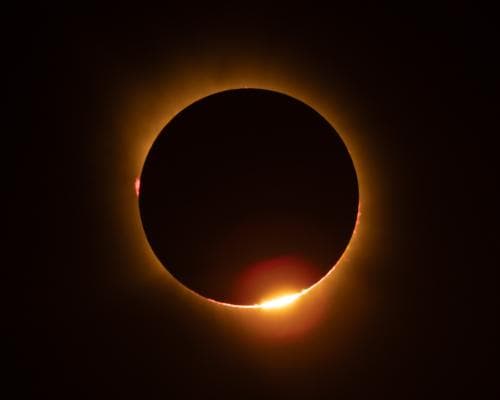
There is a moment, just before totality, when the light turns the color of old brass and the birds stop singing. Lisa Redfern, standing on a Cornish clifftop, called it “magical eeriness”—that strange, suspended breath when the sun’s power seems to falter and the familiar world tilts into the uncanny. For those of us who watched Wednesday’s partial eclipse from Britain, it was a fleeting glimpse of something profound. But for the true connoisseurs of wonder, the ones who had booked their flights months in advance, the real prize lay elsewhere: in the ribbon of totality that cut across Greenland, Iceland, and Spain, where the sun vanished entirely and the corona blazed like a liquid diamond ring against a violet sky.
This is the new frontier of luxury travel—not a private island or a Michelin-starred tasting menu, but a front-row seat to the universe’s most dramatic light show. The eclipse chase has quietly become the ultimate status journey, a pilgrimage for those who have already seen every sunset from every overwater villa and now crave something rarer. It is not about opulence in the traditional sense; it is about access to a moment that cannot be bought, only witnessed. The wealthy do not just want to see the eclipse—they want to see it from the deck of a superyacht off the coast of Iceland, or from a restored finca in the Spanish countryside, with a private astronomer on call and a bottle of vintage Rioja at hand.
The experience itself is unlike anything else in the travel canon. For a few minutes—sometimes as long as four and a half, if you have chosen your coordinates with the precision of a Swiss watchmaker—day turns to night, the temperature drops by several degrees, and the horizon glows with a 360-degree sunset. The corona, that fiery halo of plasma, shimmers in a way that photographs never capture. It is a sensory overload that leaves even the most jaded travelers speechless. “You forget to breathe,” one veteran eclipse chaser told me. “You forget you are standing on Earth.”
But this is not a journey for the spontaneous. The path of totality is a narrow ribbon, often just a hundred miles wide, and it moves at thousands of miles per hour. To catch it, you need planning, precision, and a willingness to pivot at the last minute if the clouds roll in. That is where the new breed of eclipse concierges comes in—specialist operators who charter planes, reposition yachts, and scout microclimates to give their clients the best possible odds. They are the shadow-chasers of the ultra-wealthy, and their services do not come cheap. A week-long eclipse expedition to Greenland can run upwards of $50,000 per person, with the premium placed not on the hotel but on the probability of a clear sky.
For those who missed this week’s show, the next total eclipse over Europe will not occur until 2075—a lifetime away. But the global circuit continues: North America in 2024, Egypt in 2027, Australia in 2028. Each one draws a new wave of travelers who understand that true luxury is not about owning things but about experiencing moments that cannot be replicated. The eclipse is the ultimate ephemeral asset, a dividend that pays in awe and expires in minutes. It is no wonder that the world’s wealthiest are now planning their calendars around the moon’s shadow, trading boardroom schedules for the cosmic kind.
What does this signal for the future of luxury travel? It suggests a shift away from the tangible and toward the transcendent. The ultra-rich have already mastered the art of the private safari, the Antarctic expedition, the space-adjacent balloon ride. The eclipse is the next step in that evolution—a journey that offers no souvenir except memory, no status symbol except the story of having been there. It is travel as a form of meditation, a reminder that no amount of money can buy a clear sky, and that the most profound experiences are often the ones we cannot control.
So where do the wealthy go next? They go where the shadow falls. They go to the edges of the map, to places where the infrastructure is thin but the spectacle is thick. They go to Iceland in winter, where the eclipse coincides with the aurora borealis, or to the high deserts of Chile, where the Atacama’s bone-dry air offers near-perfect viewing. They go, in short, to be humbled. And in a world that increasingly feels divided, there is comfort in coming together in awe—even if that togetherness is measured in private jets and chartered yachts, all pointed at the same darkening sky.