The Touchline as Theatre: Why the World Cup’s Most Magnetic Presence Isn’t a Player
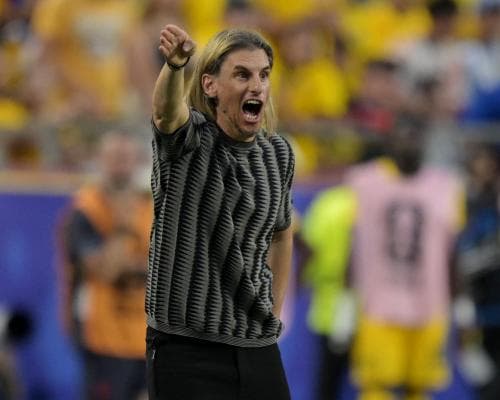
There is a particular kind of magic that unfolds when the world’s elite gather for a spectacle, and the FIFA World Cup—that quadrennial pilgrimage of nations—offers more than just the clash of cleats and the roar of goals. For those who navigate the corridors of power and privilege, the true theatre lies on the touchline, where managers become auteurs, their every gesture a brushstroke on a canvas of tension and triumph. This year, amid the sculpted grass of North American stadiums and the hushed hum of private lounges, one figure has transcended the mere tactical to become an object of fascination: Sebastián Beccacece, the 45-year-old Argentine commanding Ecuador’s campaign. With his windswept dirty-blond locks, a chinstrap of stubble that whispers of Patagonian gauchos, and a presence that commands the lens like a seasoned actor, Beccacece is not merely a coach—he is a destination unto himself, a living embodiment of the romance that high-stakes travel promises.
To understand Beccacece’s allure is to appreciate the geography of his charisma. Born in the pampas of Argentina, he carries the rugged elegance of the estancia—a world of leather, horsehide, and unspoken codes—into the hyper-polished realm of international football. His Ecuadorian side, a team of defensive steel and midfield artistry, may lack the clinical bite of Europe’s titans, but on the sidelines, Beccacece orchestrates a performance that rivals any curated gallery opening. He does not simply pace; he prowls, his Boeing 747 nose and sharp jawline cutting through the stadium’s artificial light like a figure from a Cormac McCarthy novel. For the luxury traveller who has seen every suite, every vineyard, every private island, Beccacece offers something rarer: an authentic, unscripted narrative. His press conferences are not banal recitations of formation data but studies in emotional volatility—a man who wears his passion like a bespoke suit, unafraid of the creases.
The access Beccacece provides is, in its own way, a form of bespoke travel. To follow his journey is to traverse the fault lines of South American football culture, where loyalty and flair collide. His coaching pedigree—modest by the standards of the Ancelottis and Deschamps of the world—is precisely what makes him compelling. He is the underdog’s aristocrat, a contradiction that the ultra-wealthy understand intimately: the thrill of backing an outsider who carries himself like a king. His touchline theatrics—the arms flung wide in exasperation, the slow, deliberate walk to the bench that seems to last an eternity—are performances that money cannot buy, staged in the world’s most exclusive amphitheatres. For the traveller who craves not just a seat but a story, Beccacece is the guide to a hidden layer of the World Cup experience: the raw, unfiltered emotion that no VIP pass can guarantee.
Rarity, of course, is the currency of luxury, and Beccacece’s appeal is built on its scarcity. In an era where football managers increasingly resemble corporate CEOs—clipboard-toting, data-driven, monochrome in affect—he is a throwback to a more romantic age, when a manager’s personality was as much a draw as the team’s results. His chinstrap beard, a detail that could have been lifted from a 1970s Argentine fashion editorial, is a deliberate anachronism in a world of clean-shaven minimalism. The price of witnessing his artistry is not measured in dollars but in the willingness to embrace the unpredictable: a match that could end in ecstasy or despair, a press conference that might veer into poetry or profanity. For those accustomed to curated experiences, this rawness is the ultimate luxury—an unmediated encounter with a man who has not been polished by PR firms or focus groups. It is the equivalent of discovering a hidden trattoria in the hills of Umbria, where the chef’s temper is as renowned as the pasta.
What Beccacece signals about the future of luxury travel is a shift away from passive consumption toward active immersion. The ultra-wealthy are no longer content to observe from a distance; they want to inhabit the narrative, to feel the sweat and the tension. This is why the World Cup, as a travel destination, is being reimagined not as a series of matches but as a living theatre of human drama. Beccacece, with his gaucho swagger and his willingness to bare his soul on the sideline, is the embodiment of this new ethos. He is not a product to be consumed but a force to be experienced—a reminder that the most memorable journeys are those that leave you breathless, uncertain, and utterly captivated.
Where do the wealthy go next? They follow the stories that defy expectation. They will book private charters to the next World Cup not for the final but for the group-stage match where Beccacece’s Ecuador might face a European giant, knowing that the real spectacle is the man in the technical area. They will seek out the stadiums where his silhouette cuts against the floodlights, where his gestures become folklore. And when the tournament ends, they will remember not the scoreline but the way he made them feel—like witnesses to a kind of genius that cannot be manufactured or monetised. In the lexicon of luxury travel, Sebastián Beccacece is the new frontier: a destination that exists not on a map but in the electric space between a manager and his team, a reminder that the world’s most exclusive experiences are often the ones that cannot be reserved.


.jpg%26w%3D900%26q%3D75%26output%3Dwebp&w=1920&q=75)