The Last Continent: A Voyage to the Edge of the World, Where Bird Flu Casts a Shadow Over Untouched Ice
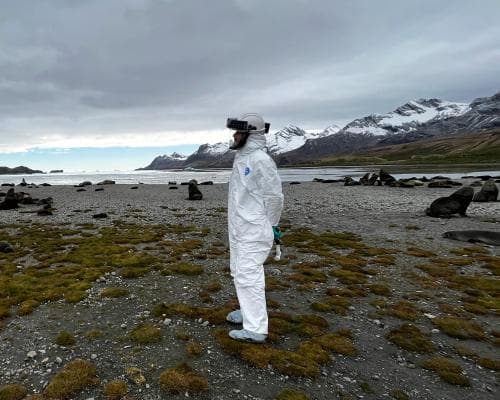
The Southern Ocean does not yield easily. For five days, the science expedition cut through heaving grey swells, the Falkland Islands shrinking to a memory as the horizon swallowed all trace of human order. Then, the smell came first—a thick, sweet decay that clung to the wind long before land appeared. Dr Jane Younger, an ecologist from the Institute for Marine and Antarctic Studies at the University of Tasmania, stood on the deck as the coast of South Georgia materialised through the mist, and saw what no luxury traveller ever wishes to witness: the bloated bodies of fur seals floating in the shallows, their pups still trying to nurse from mothers who would never stir again.
This is South Georgia, a British subantarctic territory that has long lured the world’s most intrepid travellers—those who charter private yachts or book berths on expedition ships costing upwards of $30,000 per voyage—to witness its staggering colonies of king penguins, elephant seals, and wandering albatrosses. But in early 2024, the H5N1 variant of avian influenza arrived, carried by migrating seabirds. The virus has already killed tens of thousands of seals in South America and more than 200 million poultry in the United States. Here, in this pristine wilderness, it has found a new, vulnerable host. Younger and her multinational team—scientists from the United States, France, South Africa, and the Falklands—came not for adventure but for surveillance, cataloguing the dead while the living struggled to survive.
Access to South Georgia is itself a privilege reserved for the wealthy and the determined. There are no airports, no hotels, no docks for casual visitors. The island is reachable only by sea, typically via a multi-day crossing from the Falklands or Ushuaia, aboard vessels that must navigate shifting ice fields and sudden storms. Those who do make landfall are rewarded with landscapes that seem sculpted by a divine hand: glaciers calving into fjords, beaches carpeted with tens of thousands of king penguins, and the ghostly silhouette of Shackleton’s grave at Grytviken. Yet Younger’s account strips away the romance. “From one cove to the next, we saw hundreds of giant petrels—scavengers with a two-metre wingspan—feasting on the densely packed bodies of dead fur and elephant seals,” she recalls. The smell was overwhelming, a visceral reminder that even the most remote sanctuaries are not immune to global contagion.
The rarity of such an expedition lies not in its luxury but in its urgency. Younger’s team was part of a coordinated effort that included Australian scientists on Heard Island, 6,500 kilometres to the east, where they discovered 13,000 dead elephant seal pups alongside hundreds of other seals and birds. The H5N1 strain was first detected in subantarctic seabirds in late 2023 and in South Georgia’s seal population by early 2024. The cost of mounting such a mission is immense—vessel charters, specialised cold-weather gear, satellite communications, and months of logistical planning—but it is a price that governments and private foundations are increasingly willing to pay. For the ultra-wealthy, who might charter a similar voyage for leisure, the experience now carries a new, haunting dimension: the realisation that the wild places they treasure are vanishing, not from development, but from disease.
What does this signal for luxury travel? The era of heedless exploration is over. The new frontier is one of responsibility, where the most exclusive journeys are those that contribute to science or conservation. Operators like Ponant, Silversea, and private yacht charters now offer “citizen science” itineraries in Antarctica and the subantarctic, where guests assist researchers in collecting data on wildlife health. Yet the sobering truth is that even these efforts may be insufficient. Younger describes a moment that will stay with her: “We saw an adult female fur seal. It had freshly died and the pup was still trying to suckle. The male was still trying to defend her. It was this little family unit … that was upsetting.” The image is a stark counterpoint to the glossy brochures of penguin colonies and sunset icebergs.
Where the wealthy go next is not merely a matter of latitude but of conscience. The subantarctic islands—South Georgia, Heard, Macquarie—are becoming pilgrimage sites for those who seek not just beauty but meaning. Yet the window is narrowing. As H5N1 continues its relentless spread, the very ecosystems that draw travellers may become inaccessible, quarantined to prevent further contamination. For now, the journey remains possible, but it demands a new kind of traveller: one who understands that the last continent is not a playground but a patient, and that the greatest luxury is bearing witness without looking away.


